
11th Sunday after Pentecost Proper 14A – The Rev. Mark S. Winward, MDiv,ThM
The Navy Hymn
I selected “Eternal Father” as our gradual hymn today because it’s based on today’s Gospel and because of its longstanding association with worship in the Navy and Marine Corps. That tradition, along with my Navy roots, may explain why this hymn resonates with me – and why you can count on me choosing it anytime this Gospel account pops up in the lectionary.
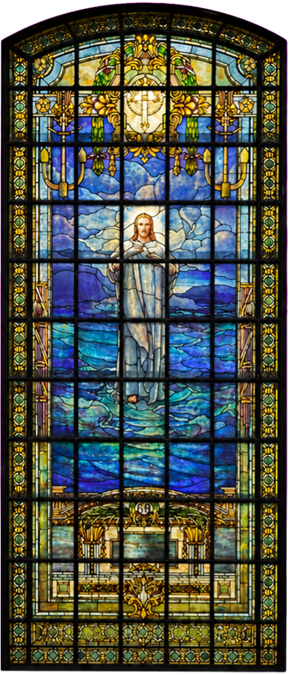
The Porter Memorial Window, shown in your bulletins, stands in the chancel of the United States Naval Academy Chapel in Annapolis. This beautiful Tiffany window portrays Christ walking on the water. For more than a century, generations of midshipmen have conducted services beneath this image. I wonder how many returning naval officers have looked upon it and heard the words of the Navy Hymn echoing in their ears:
Eternal Father, strong to save,
Whose arm hath bound the restless wave,
Who bidd’st the mighty ocean deep
Its own appointed limits keep;
O hear us when we cry to Thee,
For those in peril on the sea!
Many of you may be unaware that I didn’t begin my Navy career as a chaplain. I started out on track to become a Surface Warfare Officer in 1986, serving as Navigator aboard one ship and later as Assistant Engineer aboard another. During those years, I’ve conned ships through both fair and foul weather. I’ve felt a ship roll to within a couple of degrees of not righting itself, and I’ve seen green water wash over the pilothouse as we plunged into waves that looked like something out of The Perfect Storm.
A Storm on the Chesapeake Bay
But I’ve never been so terrified—not at sea, and not even while taking rocket fire in Iraq—as I was while sailing with my family on the Chesapeake Bay.
About twenty years ago, we rented a sailboat for a family vacation from Norfolk to Tangier Island. As we always do before getting underway, we said a prayer. Christian, our oldest son, closed it by saying, “And, dear Lord, we pray that this will be an adventure!”
It was a beautiful, sunny day, and the forecast called for fair weather. But I had enough experience at sea—and was superstitious enough as a sailor—to know that you never pray for an adventure. And an adventure it was…
We were about thirty miles north of Norfolk, near a lighthouse ominously named Wolf Trap, when we saw powerboats hightailing it toward shore. The radar showed a line of thunderstorms heading directly toward us. Our sailboat could make only seven knots on a good day, and the nearest safe harbor was twenty miles away. We weren’t going to outrun it.
The sky grew almost as dark as night, and the storm struck us with a vengeance. Waves crashed over the bow as winds pummeled the boat. It was all I could do to hold her steady. We secured a lifeline to my 16-year-old son, Christian, as he courageously fought his way to the mainmast to reef the sail. At that moment, I was struck with the terrifying thought that I might lose the boat—and my family with it.
Based on my experience, I turned the boat to take the waves at the safest angle. We rode them out, praying as we remained at the mercy of the storm. After perhaps twenty minutes of terror, the storm passed as quickly as it had arrived, and sunny skies returned. We later learned that tornadoes—none of them in the forecast—had struck the Chesapeake region. Exhausted, we anchored in a protected lagoon, where KC prepared what the boys still remember as the best homemade clam chowder they’ve ever tasted. I didn’t see Jesus walking toward us on the water that day. But I certainly understood Peter’s prayer: “Lord, save me!”
Jesus Comes Upon the Water
In today’s Gospel, we find the disciples in a boat on the Sea of Galilee, battered by the waves. Then, early in the morning, Jesus comes toward them, walking upon the sea.
First, Jesus sent them onto the water. Matthew tells us that he “made the disciples get into the boat and go on ahead to the other side.” The storm struck them while they were going where Jesus had told them to go. Following Jesus doesn’t guarantee calm seas. Sometimes obedience carries us directly into places we’d never have chosen for ourselves.
Second, the disciples didn’t recognize Jesus. They saw a figure moving across the water and cried out, “It is a ghost!” The very one who came to help them became one more reason to be afraid. Fear can cloud our judgment. When we’re scared, exhausted, or overwhelmed, we may overlook God’s presence because he doesn’t come in the form we expect. Jesus immediately called to them: “Take heart, it is I; do not be afraid.” He didn’t begin by calming the wind. He began by identifying himself. Before Jesus changed their circumstances, he reassured them of his presence.
Peter answered, “Lord, if it is you, command me to come to you on the water.” Jesus said only one word: “Come.” Peter stepped out of the boat and began walking toward Jesus. Amazingly, for a few moments, Peter did what should’ve been impossible. But when he noticed the strength of the wind, fear overcame him, and he began to sink. It would be easy to get down on Peter, but he was the only disciple willing to leave the boat. It took genuine faith to take that first step. Jesus called it “little faith,” not an absence of faith. Peter discovered that faith can coexist with fear—and that even a courageous disciple can begin to sink. When he did, Peter prayed one of the shortest and most honest prayers in Scripture: “Lord, save me!” Matthew tells us that Jesus immediately reached out his hand and caught him.
The Heart of the Story
Perhaps that’s the point of the story. Faith isn’t freedom from fear. Faith is trusting the presence and saving hand of Christ amid our fear. Faith doesn’t mean that we never become frightened, have doubts, or begin to sink. Faith is knowing whose name to call when the water rises. And grace assures us that Christ doesn’t just watch—he reaches for us.
Only after Jesus and Peter entered the boat did the wind cease. The storm wasn’t calmed before Peter was called to step out. Sometimes Jesus calms the sea before us. Sometimes he asks us to trust him while the wind is still blowing.
Like those disciples, we’re called to go where Jesus sends us, even into difficult waters. Following Christ doesn’t guarantee freedom from suffering. It means that no storm can drive us beyond his presence.
Faith means being willing to obey when Jesus calls—whether he calls us to leave the boat or to remain faithfully where we are. And when our courage fails, as it sometimes will, faith means crying out with Peter, “Lord, save me!” Our hope rests not in the strength of our faith but in the strength of the one in whom we place our faith.
Listening Together for Christ
Having now been at Holy Family for a year, I know that new programs, a new building, and new ways of doing things can bring both excitement and uncertainty – and occasionally some frustration. Faith doesn’t require us to ignore prudent questions or pretend that every new idea comes from God. It asks us to listen together for the voice of Christ amid the wind.
Are we willing to go where Jesus calls us, even when strong winds stand against us? Can we recognize Christ when he comes in ways we don’t expect? And when we begin to sink, are we willing to trust the hand already reaching toward us? The waters may not always be as calm as we expected. But no storm can carry us beyond the presence of Christ. He comes to us on the waves and says, “Take heart, it is I; do not be afraid.”
Amen.