June 11, 2025

Bill Harkins

What Merlin is teaching me…………….

The long green season of Pentecost has now begun, and the winds of the Holy Spirit were certainly present among those of us who gathered on Sunday. A deep bow of gratitude to all who contributed so much to make this a wonderful day, including the worship team, and the choir—including our intrepid bell ringers! And especially the hospitality and parish life committees, who, as ever, graciously hosted us for the Pentecost sing along. Indeed, there was a sweet, sweet spirit in that place!

There’s a sweet, sweet Spirit in this place,

And I know that it’s the Spirit of the Lord;

There are sweet expressions on each face,

And I know they feel the presence of the Lord.

~ Music and Lyrics by Doris Akers

As Pentecost begins, I encourage each of us, me included, to slow down, and ease into summer and this season with perhaps a new rhythm, trusting that all shall be well, and remembering that we need not add more (unnecessary) items to our “to do” list. Sometimes I need help in slowing down, and on occasion that assistance has come from unexpected places!

When I was in the 8th grade, I was the only member of the Sandy Springs High School football team (back then, high school began in 8th grade) who was still in Boy Scouts. For reasons I never understood, most of my football teammates had left scouting, believing that it was no longer “cool” and/or perhaps simply under duress of scheduling challenges. I hung on as long as I could, but the latter issue proved my scouting downfall. Our pack leader was the great grandson of a Confederate General, and a certain rigidity had somehow gotten passed down into the DNA of the family. He was an “either/or” kind of guy for whom non-binary options were, sadly, anathema. I was told that being late to the Scout/BSA pack meetings because of football practice was simply not acceptable. He had a “three strikes and you’re out” rule, and after my third instance of tardiness (at age 12-13 I was still dependent on my parents for transportation) I was unceremoniously dismissed.

I had been working on my ornithology badge at the time, and had completed all the requirements necessary, only to fall short due to my untimely expulsion. The thing is, I loved Scouting and found core values of discipline and structure to be a gift. I learned some of those values there, and they have proven a moveable feast, and have endured over time. I want to add that a life in academia, summers working in a steel mill, and certainly, athletics provided similar gifts. I am still a runner today because of the ongoing joy and, yes, discipline it provides.

In the ensuing years, as Vicky can attest, I have always had bird feeders around and I’ve assiduously recorded their seasonal migrations and habits. This led to unexpected joys, including a deep dive into the study of Ravens (Corvus Corax Common raven – Wikipedia), a result of a number of wilderness encounters with ravens over the years. I once saw a raven, sitting atop a red light in Petersburg, Alaska drop a crab carcass in the middle of an intersection when the light turned green. Cars ran over the carcass, cracking it open and revealing the delicacy of crabmeat, now a kind of ala carte offering. When the light turned red, the raven flew into the intersection, retrieved the offering, and flew off loudly announcing a successful bit of culinary mischief. In Episcopal churches in Southeast Alaska, popular among the Tlingit indigenous tribe, one can find totems honoring the raven clan:

And as announced on NPR yesterday, ravens are now nesting with greater frequency in North Georgia…  

Rare ravens return to Georgia to nest – WABE  

But I digress.  

Despite, or perhaps precisely because of my inappropriate dismissal from scouting, I have so enjoyed my adventures in avian learning. Recently, I downloaded the Merlin app…  

Merlin Bird ID – Free, instant bird identification help and guide for thousands of birds – Identify the birds you see  

…which makes possible immediate identification of birds wherever one may be. On a recent trail run in Montana with our son Justin, here’s a brief list of birds I identified via the Merlin app:  

Western Meadowlark (Montana state bird); Western Wood Pe-Wee; Yellow Warbler; Bald Eagle; Least Flycatcher; House Finch  

In Montana, my times out on the trail were much slower, both as a result of the scenery…

…and my new Merlin App!

Well, you get the idea. I am grateful to Justin for his patience as I stopped on the trails to use the app and identify birds while on our runs. We love trail running together, as does his younger brother Andrew, and we have delighted in those rare occasions when we can do this together…

On a recent trail run up to Mt. Oglethorpe, in our neighborhood, here are a few “listening’s”:

Red Eyed Vireo; Yellow Throated Vireo; Pine Warbler; Red-Bellied Woodpecker; Eastern Bluebird; Hooded Warbler

Fellow avian-loving sojourners will immediately recognize that the woods this time of year are filled with migrating warblers, typically not year-round residents of our mountains. Each of my recordings required that I pause on the trail, take out my phone, turn on the app, and record the songs I was hearing. As a lifelong runner often too preoccupied with clock time (Chronos) as opposed to spirit time (Kairos) Merlin is helping me to remember what is most important about these woodland peregrinations…namely, slowing down, paying attention, and letting nature heal mind, body, and spirit.

In Pentecost we are reminded that God is among us, abide with us, and that we can welcome the Holy Spirit, our advocate, no matter where we are on our journey. As the lovely author Marilynne Robinson as written:

“It has seemed to me sometimes as though the Lord breathes on this poor gray ember of Creation and it turns to radiance – for a moment or a year or the span of a life. And then it sinks back into itself again, and to look at it no one would know it had anything to do with fire, or light. This is what I said in the Pentecost sermon. I have reflected on that sermon, and there is some truth in it. But the Lord is more constant and far more extravagant than it seems to imply. Wherever you turn your eyes the world can shine like transfiguration. You don’t have to bring a thing to it except a little willingness to see. Only, who could have the courage to see it?”

~ Marilynne Robinson

Indeed, our willingness during Pentecost to slow down, find a new rhythm, and pay attention to the extravagant radiance available to us is ours to choose when and how we are able. As my time as interim priest among you ends, and I take a deep breath, and as Vicky and I reconnect with our families in Montana and Houston, I am so very grateful for Holy Family, and for this sacred time together over the past year. Thank you so much for the wonderful sendoff party, for the lovely gifts of art supplies and a lovely, beautifully woven quilt, and for the many notes and well-wishes Vicky—my partner in life and ministry of 43 years—and I have received.  Thank you! And we give thanks that our new rector, Mark Winward, will be joining us soon, and for his good health report!

Recently, deep in the woods, I thought I heard the faint call of a raven just over the next ridge. My Merlin app couldn’t pick up the sound, but I am certain that’s what it was. I was reminded of this lovely poem by Wendell Berry:

Horseback on Sunday morning,

harvest over, we taste persimmon

and wild grape, sharp sweet

of summer’s end. In time’s maze

over fall fields, we name names

that rest on graves. We open

a persimmon seed to find the tree

that stands in promise,

pale, in the seed’s marrow.

Geese appear high over us,

pass, and the sky closes. Abandon,

as in love or sleep, holds

them to their way, clear

in the ancient faith: what we need

is here. And we pray, not

for new earth or heaven, but to be

quiet in heart, and in eye, clear. What we need is here.

~ Wendell Berry, Wild Geese, Selected Poems

Indeed, all shall be well, and yes, what we need is here. Let’s covenant to slow down this summer, shall we? Let’s take care to “pay attention, be astonished, and tell about it…” as our fellow Episcopalian Mary Oliver suggested. On our recent trip to Montana we watched our granddaughter Alice and her Real Billings Football Club (8-year-olds) demonstrate remarkable skills on the pitch, and her twin brother Jack as he won the 100-meter run. I was reminded of Eriksons’ developmental stages of life, the penultimate of which is “generativity v. despair.”

In the generativity stage, we contribute to the next generation in ways that allow us to transcend time, planting sequoias, as Wendell Berry suggests, that we will not live to see fully grown. This allows us to live with integrity in our final stage, letting go of attachment to former narratives. I was the Fulton County schoolboy 100-yard dash champion when I was 12 years old, but I saw my grandson run a faster time at age 8 last week. I was glad about this, and for the reminder that ultimately, time is more about Kairos than Chronos. Indeed, Jack and Alice, and the raven, and my Merlin app, are all teaching me that what we need is here, and we pray to be quiet in heart, and in eye, clear.

I’ll catch you later down the trail, and I pray Pentecost blessings on you all!

Godspeed, Bill

April 24, 2025

Bill Harkins

Quantum Entanglement, Higgs Bosun, Gabriel Marcel, and Holy Family!

Well, I’ve done it again! Against all odds, another Notes from the Trail! Still, as I drove to the Cathedral Counseling Center early on Monday morning, I was filled with gratitude for all of you, and I wanted to say “Thank you”! Thank you for all that you did to make this a memorable Holy Week in every way, from adapting to safe practices on Palm Sunday with grace and good humor, to services each and every day during Holy Week, especially Maundy Thursday and Good Friday, and a glorious morning on Easter beginning with the Vigil and on to our lovely service at 10:30. Thanks to everyone from Hospitality and the Altar and Flower Guilds, to our amazing Digital Ministry and our Verger and LEM crew! A deep bow of gratitude for my dear colleagues Katharine and Byron, our incredible choir & friends, led by John King Carter, and even the newest iteration of our Bell Choir! Thank you all! Yes, indeed, we are all connected to one another, and in the breaking of the Bread, we too become the Body of Christ, sent out to do that good work to which we are called. At table, we find ourselves experiencing God’s grace, and joy, in wonderful and surprising ways. We welcome all to our Table, including Caroline and her guest, Gerald the Giraffe:

In Quantum physics, we know that elementary particles gain mass through interactions with the “Higgs field.” Similarly, the Higgs boson gains mass in the same way. It is called the “God Particle” because it is the basis of the formation of atoms and keeping the universe in order. Without the Higgs field, particles wouldn’t have mass, and the universe, as we know it, wouldn’t exist. 

Richard Rohr reminds us that just as different ways of interpreting scripture and various types of truth (e.g., literal vs. mythic) are valuable for different purposes, so scientific theories have different applications while seeming to be paradoxical and irreconcilable. For example, we have the Newtonian theory of gravity, Einstein’s theory of relativity, and quantum theory. Physicists know that each of them is true, yet they don’t always fit together, and each is limited and partial. Newtonian mechanics can’t model or predict the behavior of massive or quickly moving objects. Relativity does this well, but doesn’t apply to very, very small things. Quantum mechanics succeeds on the micro level. But we don’t yet have an adequate theory for understanding very small, very energetic, very massive phenomenon, such as black holes. Scientists are still in search of a unified theory of the universe.

Perhaps the term “quantum entanglement” names something that we have long intuited, but science has only recently observed. Here is the principle in layperson’s terms: in the world of quantum physics, it appears that one particle of any entangled pair “knows” what is happening to another paired particle—even though there is no known means for such information to be communicated between the particles, which are separated by sometimes very large distances. As Richard Rohr asks, could this be what is happening when we “pray” for somebody? Scientists don’t know how far this phenomenon applies beyond very rare particles, but quantum entanglement hints at a universe where everything is in relationship, in communion, and where that communion can be resisted (“sin”). Both negative and positive entanglement in the universe matter, maybe even ultimately matter. Prayer, intercession, healing, love and hate, heaven and hell, all make sense on a whole new level. Almost all religions have long pointed to this entanglement. In Paul’s letter to the Romans (14:7) he says quite clearly “the life and death of each of us has its influence on others.” The Apostles’ Creed states that we believe in “the communion of saints.” There is apparently a positive inner connectedness that we can draw upon if we wish. There are pathways that connect us in ways we may not always appreciate:

But we must be willing to “show up” and be available. Gabriel Marcel, a theologian and philosopher whose work I have long admired, suggests that availability (disponibilité) refers to a state of being actively open and receptive to others, not just physically present, but also engaged in a deeper intersubjective relationship. It involves welcoming the other into one’s interiority and being ready to respond to their needs or presence. And Marcel’s concept of availability goes beyond mere physical presence. It emphasizes an active attitude of openness and receptivity to others. Availability is crucial for forming genuine intersubjective relationships, where individuals recognize each other as subjects with their own interiority and experiences. Being available involves welcoming others into one’s inner world, engaging with their perspective, and being open to their needs and presence. 

We do this when we gather for worship, when we pray for others, and when we extend what we receive there out into the world, giving ourselves away with compassion, justice, and grace:

Theologian Ilia Delio says, “If reality is nonlocal, that is, if things can affect one another despite distance or space-time coordinates, then nature is not composed of material substances but deeply entangled fields of energy; the nature of the universe is undivided wholeness.” Delio described this phenomenon as an experiential “force field” or the Holy Spirit. In Trinitarian theology, the Holy Spirit is foundationally described as the field of love between God and the Son. One stays in this positive force field whenever one loves, cares, or serves with positive energy. Delio reminds us that when people stand in this place, when they rest in love as their home base, they become quite usable by God, and their lives are filled with “quantum entanglements” that result in very real healings, forgiveness, answered prayers, and new freedom for those whom they include in the force field with them. Jung called these events “synchronicities”; secular folks call them coincidences; others called them Divine Providence.

Indifference is, I suspect, the opposite of this way of being in the world. And if so, it would surely follow that each of us moves things along in the direction of healing each time we choose to love. Each time it is a conscious choice and a decision, at least to some degree. Grace and guilt both glide on such waves of desire and intention. Light, both particle and wave, reveals connections between and among us we may not always see:

As Rohr and Delio remind us, consciousness, desire, and intentionality matter. Maybe they even create and destroy worlds. We cannot afford to harbor hate or hurt or negativity in any form. We must deliberately choose to be instruments of peace—first, in our minds and hearts and in our prayer life. Such daring simplicity is quantum entanglement with the life and death of all things. We largely create both heaven and hell. God is not “in” heaven nearly as much as God is the force field that allows us to create heaven through our intentions and actions. Once quantumly entangled, it seems we are entangled forever, which is why we gave such finality and urgency to our choices for life (heaven) or death (hell).

And yes, gratitude connects us as well. I am so very grateful for this Holy Family parish. We do not know what the future may bring, or how our “entanglement” with one another and the Holy Spirit that binds us together may unfold. But we do know that God will not leave us alone.

On Monday, after a morning of seeing patients, I walked across the Cathedral Close to the Nave of the Cathedral. I thought about our parish, and all the ways we are connected to one another, of my 18 years of service at St. Philip, of the joy of being at Holy Family once again, and I was filled with gratitude. Entanglement indeed!

When we show up, and make ourselves available, we become part of something much, much greater than ourselves alone.

And then, we give ourselves away in love. As Mary Oliver says, “And what do I risk to tell you this, which is all I know?

Love yourself. Then forget it. Then, love the world.”

And this, from Wallace Stevens, about the mystery of our entanglements with God, the Holy Spirit, and one another…

Here, now, we forget each other and ourselves.

We feel the obscurity of an order, a whole,

A knowledge, that which arranged the rendezvous.

Within its vital boundary, the mind.

We say God and the imagination are one…

How high that highest candle lights the dark.

Out of this same light, out of the central mind,

We make a dwelling in the evening air,

In which being there together is enough.

~Wallace Stevens

I am so very grateful to each of you, and for our beloved Holy Family. No matter what the future brings, or where we are sent, we share the common bond of God’s enduring, miraculous, grace-filled love. You, we, all of us are meant to be the Light of Christ in the world.

I’ll catch you later down the trail.

Bill+

April 15, 2025

Tuesday in Holy Week – Bill Harkins

Now among those who went up to worship at the festival were some Greeks. They came to Philip, who was from Bethsaida in Galilee, and said to him, “Sir, we wish to see Jesus.” Philip went and told Andrew; then Andrew and Philip went and told Jesus. Jesus answered them, “The hour has come for the Son of Man to be glorified. Very truly, I tell you, unless a grain of wheat falls into the earth and dies, it remains just a single grain; but if it dies, it bears much fruit. Those who love their life lose it, and those who hate their life in this world will keep it for eternal life. Whoever serves me must follow me, and where I am, there will my servant be also. Whoever serves me, the Father will honor. “Now my soul is troubled. And what should I say—‘Father, save me from this hour’? No, it is for this reason that I have come to this hour. Father, glorify your name.” Then a voice came from heaven, “I have glorified it, and I will glorify it again.” The crowd standing there heard it and said that it was thunder. Others said, “An angel has spoken to him.” Jesus answered, “This voice has come for your sake, not for mine. Now is the judgment of this world; now the ruler of this world will be driven out. And I, when I am lifted up from the earth, will draw all people to myself.” He said this to indicate the kind of death he was to die. The crowd answered him, “We have heard from the law that the Messiah remains forever. How can you say that the Son of Man must be lifted up? Who is this Son of Man?” Jesus said to them, “The light is with you for a little longer. Walk while you have the light, so that the darkness may not overtake you. If you walk in the darkness, you do not know where you are going. While you have the light, believe in the light, so that you may become children of light.”

Grace and peace to you all this Tuesday afternoon in Holy Week. It’s a lovely, windy day in the Southern Appalachians, filled with spring sunlight, and the world coming back to life after a long winter. As a collector and connoisseur of light, I hold memories of the experience of light deep within my soul, and those memories sustain and enliven and enrich my experience of being alive. As I ran the trails yesterday, on a similar afternoon to this one, I was so grateful for the quality of light, and the beauty of the day. The dogwoods and azaleas in Decatur are in full bloom, and it was a day which was the essence of late March, with deep blue skies, brisk winds, and a wonderful slant of light. Had someone walked up to me and said, “Bill, go fly a kite!” I would have said immediately, “Yes. Good idea. I believe I will.

I have stored in my memory a collection of such days of remarkable light. They each involve a transformation of a way of seeing the world, perhaps even a momentary glimpse of the sacred amid the ordinary. Each experience involves a liminal, threshold space, where light seems to symbolize the passage into a new perspective. I recall the remarkable quality of light on a day in Maine, leaving Stonington Harbor in a kayak, looking back at the town as the sunlight, filtered through a dissipating fog, cast a beautiful glow on Penobscot Bay and reflected off the head of a curious harbor seal, greeting my passage there. I recall the fiery glow of the constellation Cassiopeia, seen through a telescope one deep night in June, and realizing that the light from this beautiful interstellar space left there two thousand years ago, about the time of Jesus’ birth, only now reaching my eyes. I recall the light reflected in the eyes of my sons as they were born and the many moments since, filled with all the joys of parenting. I remember the light of the sun filtering through the stained glass windows in the Cathedral of St. John the Divine on a late October day in New York City, after completing the New York City Marathon, giving thanks for a safe run. And I remember a remarkable day running on the trails near Mt. LeConte with my best friend Mark, now gone for many years. We were caught in a spring snowstorm, through which the sun momentarily emerged, reflecting off every limb and every snowflake, encasing us in a wondrous cocoon of light. I recall a day in March, or maybe April, many years ago, having fallen asleep in a hammock at my grandmothers’ farm, awaking to the sound of spring breezes in the trees, blowing the nearby wind chimes, and seeing the instant I opened my eyes her hand-made quilts, lovingly created, hanging in the bright spring sunlight and reflecting back the many colors of her loving, generous spirit.

And these are just a few. Conversely, the darkness we each experience, the absence of light which by contrast makes us appreciate the light we hold so dear… “Midway this life we’re bound upon…”, wrote Dante, “I woke to find myself in a dark wood, the right way was wholly lost and gone. Wendell Berry reminds us that…

To go in the dark with a light is to know the light.

To know the dark, go dark. Go without sight,

and find that the dark, too, blooms and sings,

and is traveled by dark feet and dark wings.

And the Zen saying which I like so much…

And a favorite Zen koan,

Barn burned down. Now I can see the moon. ~Basho

Themes of darkness and light are a part of our Lenten journey.

On such a day as today, I can best imagine the feeding of the five thousand taking place. There, in my mind’s eye, the people sit down expectantly, high on the mountain above the Sea of Galilee. We are told that there was a great deal of grass there. I imagine a day of dazzling sunlight, capturing the green of the grass, the deep blue of the sky, and the light reflected off the water nearby, creating a synesthesia of light and energy. And in my imagination this light energy radiates and grows, infusing the scene with a holy shimmering of grace which transforms everything, and everyone present. In one of his poems Gerard Manly Hopkins has written;

The world is charged with the grandeur of God.

It will flame out, like shining from shook foil;”

Yes, as the Gospel for Tuesday in Holy Week reminds us, we are called to be children of light, and we know the light in part because we are acquainted with darkness. This is what our journey from Palm Sunday to Easter is about, and it is why the Triduum, beginning with Maundy Thursday, is so very important to that journey and to the Light of Christ we celebrate on Easter Sunday. Let’s remember, on days like today, the miracle of photosynthesis in which trees, during the day, take in carbon dioxide and water, and with sunlight, they perform photosynthesis to produce sugar (food) and oxygen. This process occurs primarily in the leaves. At night, in the darkness, trees respire, releasing carbon dioxide and taking in oxygen. Without the inextricably interconnected relationship between darkness and light, life as we know it would not be possible.

As many of you know, our parish has been especially hard hit by a wave of Covid infections. This includes many members of the vestry, worship committee, our intrepid digital ministry, and especially our choir, whose ranks were hard hit. We were so fortunate to have Roxanne Golden substitute for us on Sunday as organist, and the faithful remnant of our choir performed marvelously, including the glorious Ave Verum Corpus, by Mozart. Thank you so much!

Sadly, due to public health concerns we were unable to process as usual on Palm Sunday for the Liturgy of the Palms, as walking and singing are sure to spread the virus efficiently! If you are immunocompromised in any way, please take care and use your best judgment as we approach the Triduum of Maundy Thursday, Good Friday, and Easter. We have N95 masks available, and they will be placed on the credenza in the narthex.  

Please hold those who are ill in your prayers, and especially in this season we remember in our prayers Norma Niehoff-Emerson, who recently lost her husband Rob, and Jennie Sheffield, whose sister Elizabeth Bryan Drennen (“ Betty”) passed away peacefully on the evening of April 9th at age 95. And our dear Deacon Katharine recently lost her lifelong friend Ann Payne. Please keep Katharine, Scott, and the Payne family in your hearts and prayers.

Yes, there is darkness, but we are Easter people, and we are children of light…the Light of Christ!

Please forgive this ‘extra” Notes from the Trail in the form of a public service announcement! Holy Week blessings, please do take care of yourselves, and watch us online this Sunday if you have any health concerns. I’ll catch you later down the trail!

Bill+

March 19, 2025

Bill Harkins

The physical structure of the Universe is love. It draws together and unites; in uniting, it differentiates. Love is the core energy of evolution and its goal.”

~ Teilhard de Chardin, Human Energy

Last week Vicky and I enjoyed a visit to the Fernbank Science Museum with our younger son Andrew, daughter-in-law Margaret, and grandchildren Sophia and Georgie. We have always enjoyed our sojourns to Fernbank Don’t Miss This Ultimate Exhibit at Fernbank and have fond memories of taking both of our sons there when they were young, so the tradition continues! 

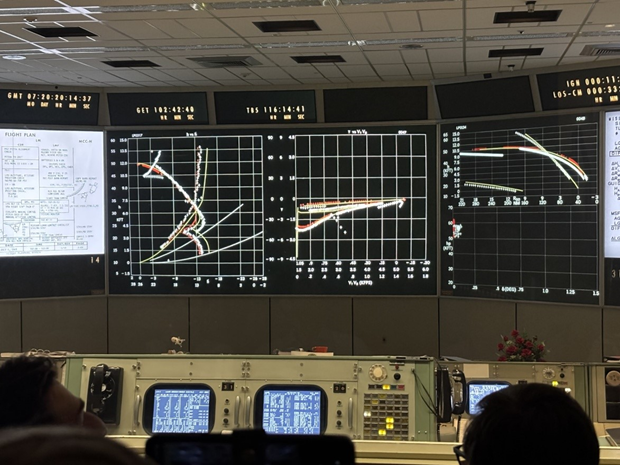
The week prior our older son Justin, and his family, Michelle, Alice, and Jack, who live in Montana, visited Andrew, Margaret and family in Houston, where Andrew is an oncology fellow at MD Anderson They visited the NASA space center there and saw the “mission control” center where so much history has been made…”Houston, we have a problem.” 

We hoped our children would develop a sense of wonder in the natural world and an interest in science, and now we delight in spending time with our grandchildren in these contexts as well!

In 1982 I enrolled at Vanderbilt Divinity School on a trial year Lily Foundation scholarship. Vicky and I journeyed to Nashville primarily for her to work on a Master’s in Behavioral Health Nursing, while I considered resuming my interest in neuroscience upon our eventual return to Atlanta, where I had been working in the Neuroendocrinology Research Lab at GMHI. Instead, we remained at Vanderbilt for doctoral work in psychology and religion. It is among my intellectual and spiritual homes. At the time there were over 40 faith traditions represented at Vanderbilt, and I delighted in the learning that accrued among so many different perspectives! Interaction and interdisciplinary learning between the departments of psychology, philosophy, and religion was robust, and this, too, created a wonderful milieu for learning.

One of my favorite professors was Dr. John Compton, who taught courses in philosophy of science, and the intersection of science and religion. He was a brilliant teacher whose father, Arthur Compton, was a Nobel Laureate who worked on the Manhattan Project at Los Alamos, New Mexico, where John attended High School. John encouraged us to engage in the dialogue between science and religion, ask tough questions, and enjoy the ambiguous spaces between the Hegelian dialectic of thesis, antithesis, and synthesis. We read Thomas Kuhn’s book The Structure of Scientific Revolutions (1962) which challenged the view of scientific discovery in which progress is generated and accelerated by a particular great scientist. Rather, Kuhn suggested, new discoveries depend on shared theoretical beliefs, values, and techniques of the larger scientific community—what he called the “disciplinary matrix” or “paradigm.” Several years ago, we journeyed to Santa Fe and Los Alamos to run the Jemez Mountain Trail Races…

…and we visited the museum in Los Alamos where Arthur Compton and colleagues worked on the Manhattan Project Bradbury Science Museum | Los Alamos National Laboratory

Building upon this idea of the disciplinary matrix, scholars identified attitudes towards gender and race as among those shared values and beliefs and suggested that we need in order to question the way in which histories of science recount who does what, and who gets credit. Evelyn Fox Keller, writing in her book Reflections on Gender and Science, suggested that science is neither as impersonal nor as cognitive as we thought. And it is not reserved for male geniuses working on their own. It occurs through collaboration. This includes religious values, critical inquiry, and dialogue. Collaboration is also a key component of “emotional intelligence,” defined as the ability to manage both your own emotions and anxiety and understand the emotions of people around you.

There are five key elements to Emotional Intelligence: self-awareness, self-regulation, motivation, empathy, and social skills. People with high EI can identify how they are feeling, what those feelings mean, and how those emotions impact their behavior and in turn, other people. It’s a little harder to “manage” the emotions of other people – you can’t control how someone else feels or behaves. But if you can identify the emotions behind their behavior, you’ll have a better understanding of where they come from and how to best interact with them. This, too, is ultimately about a collaborative spirit, and openness to a sense of wonder. It can save us from micromanaging narratives that, ultimately, we cannot control, and allow us to co-create contexts for growth, and new paradigms of hope, wonder, and shared learning.

High Emotional Intelligence overlaps with strong interpersonal skills, especially in the areas of conflict management and communication – crucial skills in the workplace, and especially important for scientific discovery and organizations during times of transition! 

The year Kuhn’s text was published, the Mercury Friendship 7 mission occurred. John Glenn, piloting the spacecraft, was returning to earth when the automatic control system failed, forcing him to manually navigate the capsule to touchdown. Katherine Johnson, one of the (“Hidden Figures”) African American mathematicians working for NASA, calculated and graphed Glenn’s reentry trajectory in real time, accounted for all possible complications, and traced the exact path that Glenn needed to follow to safely splash down in the Atlantic.

Such stories amplify and deepen the work of Kuhn, Keller, and others who encourage us to create a future in which more and different people—regardless of race, gender, religion, class, or sexual identity—can imagine themselves as participants in new unfolding discoveries and creating new possibilities during times of change. This includes our church communities as well! Much is changing, of course, in mainline Protestantism and in our own denomination, and at Holy Family too! A collaborative, lay-led and clergy supported paradigm can assist us as we find our way in this new season.

At heart, these narratives evoke the relationality of Creation, and God’s love, an evolving, divine, dynamic energy. As the poet Wallace Stevens said, “Nothing is itself taken alone. Things are because of interrelations or interactions.”

And as Ilia Delio has written, “If being is intrinsically relational (as the Trinity evokes) then nothing exists independently or autonomously. Rather, “to be” is “to be with” …I do not exist in order that I may possess; rather, I exist in order that I may give of myself, for it is in giving that I am myself.”[I]

Or, as Mary Oliver said so well,

“And what do I risk to tell you this, which is all I know?

Love yourself. Then forget it. Then, love the world.”

Sounds like a relational, collaborative, Trinitarian Gospel to me, and during this season of Lent, this might be an especially important component of our Lenten discipline and discernment! Let’s be open to wonder, and hope, and imagination as we view the world around us, and not allow old narratives or anxieties keep us in bondage. Let’s covenant to cultivate wonder and give of ourselves as Delio implores us to do! Paying attention in those threshold, liminal spaces where the world awaits us is a sacred task indeed! After all, as Teilhard said so well, “Love is the core energy of evolution, and its goal.”

Friends, this will be my final episode of Notes from the Trail as I transition out of my role as interim, and as we prepare to welcome its new rector. I pray blessings upon you all, and I give a deep bow of gratitude for the honor of having served this past year. Godspeed, and I’ll catch you later down the trail! Bill+

[i] Ilia Delio, The Unbearable Wholeness of Being: God, Evolution, and the Power of Love (2013), Orbis Books

March 12, 2025

Bill Harkins

Today is the Feast Day of Gregory the Great, thought by many to be the “father” of pastoral care. Truth told there are many mothers and fathers in the history and tradition of pastoral care and pastoral theology, but he was among the first, and we honor his work in our own “Lesser Feasts and Fasts” and “Holy Women, Holy Men.” 

Gregory was born into a Patrician family in about 540 and became Prefect of Rome in 573. Shortly thereafter, however, he retired to a monastic life in a community which he founded in his ancestral home on the Coelian Hill. Pope Pelagius Il made him Ambassador to Constantinople in 579, where he learned much about the larger affairs of the church. Not long after his return home, Pope Pelagius died of the plague, and in 590, Gregory was elected as his successor.

Gregory wrote eloquently about the demands of the pastoral office and the dangers of seeking it too rashly. He said: “Those who aspire to the priesthood usually delude themselves into thinking that they are seeking it out of a desire to perform good works, although this actually stems from pride and a desire to accomplish great things. Thus, one thing takes place in their conscious mind, but another motive is hidden secretly within. For the mind frequently lies to itself about itself, pretending that it loves the good work when it does not, and that it does not care for worldly glory when in fact it does. The mind often has appropriate trepidation about seeking office, but once a leadership position has been secured, it assumes that it has achieved what it rightly deserves. When it begins to enjoy its newfound superiority, it quickly forgets all of the spiritual thoughts that it once had.

Indeed, in both my clinical work and consultations with small businesses and congregations, I have seen so often that leadership goes off the rails when the leader has lost the capacity for humility, and appropriate vulnerability, and transparency. I told my doctoral students that as long as I was working with patients, and congregations, and students, I would be in a clinical/pastoral consultation accountability group. We need others to keep us humble, and we need disciplines and practices to remind us that we live in a non-dualistic universe of “both/and” rather than “either/or.” Once we begin to believe that our way of being in the world is the only way, and we think that the rules that apply to others do not apply to us, we risk narcissism, and we lose the capacity for empathy. Among Gregory’s quotes is that “The test of Leadership is what happens when you leave.” I agree.

In the living out of the “priesthood of all believers” it is essential that we recognize that, ultimately, it’s not about us. Indeed, I believe there are parallels between the concept of quantum entanglement in physics and the idea of a divine interconnectedness or “oneness” with God, suggesting that the seemingly instantaneous correlation between entangled particles could reflect a deeper, spiritual connection between all things, potentially signifying God’s omnipresence and the interconnected nature of creation. If we are all connected, and if God is in and of each of us—if we are created Imago Dei—we do well to see appropriate vulnerability and humility as the true signs of leadership, as Gregory reminded us. And as Mary Oliver suggests here:

On the outskirts of Jerusalem

the donkey waited.

Not especially brave, or filled with understanding,

he stood and waited.

How horses, turned out into the meadow,

leap with delight!

How doves, released from their cages,

clatter away, splashed with sunlight.

But the donkey, tied to a tree as usual, waited.

Then he let himself be led away.

Then he let the stranger mount.

Never had he seen such crowds!

And I wonder if he at all imagined what was to happen.

Still, he was what he had always been: small, dark, obedient.

I hope, finally, he felt brave.

I hope, finally, he loved the man who rode so lightly upon him,

as he lifted one dusty hoof and stepped, as he had to, forward. + Mary Oliver

Gregory suggested that when “thoughts begin to stray, it is good to direct them back to the past, and for a person to consider how he behaved while still under authority.” He believed that no one could learn humility in a position of leadership who did not learn it when s/he was in a position of service and humility. “No one will know how to flee from praise when it abounds if he secretly yearned for praise when it was absent. Therefore, let each person judge his own character on the basis of his past life so that the fantasy of his thoughts will not deceive him.” Put another way, the musician Sting (of the Police) reminded us that “When you find your servant, there’s your master.”

Gregory’s pontificate was one of strenuous activity. He organized the defense of Rome against the attacks of the Lombards and fed its populace from papal granaries in Sicily. In this, as in other matters, he administered “the patrimony of St. Peter” with energy and efficiency. His ordering of the church’s liturgy and chant has molded the spirituality of Western Christianity until the present day. His writings provided succeeding generations with several influential texts, especially his Pastoral Care, which remains to this day a classic text on the work of Christian ministry. Gregory understood well the intricacies of the human heart and the ease with which growth in holiness may be compromised by self-deception. He wrote: “The pastor must understand that vices commonly masquerade as virtues. The person who is not generous claims to be frugal, while the one who is a prodigal describes himself as generous. Thus, it is necessary that the director of souls discern between vices and virtues with great care.”

Much later, the psychiatrist Carl Jung would write about the “shadow” of self-deception among leaders, especially autocratic leadership. Jung’s work emphasizes the need for leaders to understand their own motivations, biases, and unconscious patterns. This self-awareness is crucial for making ethical decisions and fostering trust within an organization, including churches. Jung believed that the process of individuation, or integrating the various aspects of the psyche, is essential for personal growth and wholeness. Effective leaders are those who have progressed on this path, allowing them to see the world more clearly and act with greater authenticity. In recognizing and addressing their own self-deceptions, leaders can become more authentic and empathetic, creating a more positive and productive environment. Authentic leadership fosters trust, collaboration, and innovation. Gregory understood this, and he knew that true leadership requires humility, and transparency, and yes, appropriate vulnerability.

Amid all his cares and duties, Gregory prepared and fostered the evangelizing mission to the Anglo-Saxons under St. Augustine and other monks from his own monastery. For this reason, the English historian Bede justly called Gregory “The Apostle of the English.” Gregory died on March 12, 604 and was buried in Saint Peter’s Basilica. His life was a true witness to the title he assumed for his office: “Servant of the servants of God.”

Blessings on your Lenten journey, and I’ll catch you later on down the trail…and I hope to see you in church! Bill+

March 5, 2025

Bill Harkins

Matthew 6:1-21   6“Beware of practicing your piety before others in order to be seen by them; for then you have no reward from your Father in heaven. 2“So whenever you give alms, do not sound a trumpet before you, as the hypocrites do in the synagogues and in the streets, so that they may be praised by others. Truly I tell you, they have received their reward. 3But when you give alms, do not let your left hand know what your right hand is doing, 4so that your alms may be done in secret; and your Father who sees in secret will reward you.  

5“And whenever you pray, do not be like the hypocrites; for they love to stand and pray in the synagogues and at the street corners, so that they may be seen by others. Truly I tell you, they have received their reward. 6But whenever you pray, go into your room and shut the door and pray to your Father who is in secret; and your Father who sees in secret will reward you.

Today is Ash Wednesday, and many of us will receive the imposition of ashes with the words, Remember you are dust, and to dust you shall return.As we discussed in our final “Walk in Love” class on Sunday, Lent is based on the 40 days Jesus spent in the wilderness being tempted by Satan, a Hebrew word meaning “adversary.” I have long understood this to mean that Jesus, being both fully human and fully divine, faced the same temptations with which we are often faced. Theologian Henri Nouwen described these in this way:

Nouwen argues that the first temptation, to turn stones into bread, represents the temptation to focus on immediate needs, immediate gratification, and appearances, rather than on a deeper spiritual purpose. Jesus, instead, chooses to prioritize the Word of God over satisfying immediate hunger. This can often take the form of needing to be in control and the abusive misuse of power.

The second temptation, to jump from the temple parapet, represents the allure of seeking attention and validation through dramatic displays rather than through genuine service and humility. Jesus refuses to be a “stunt man” and instead chooses to live a life of service and obedience. This can also be understood as the need to be special, and can lead to narcissistic, entitled behavior.

The third temptation, to worship Satan in exchange for worldly power, represents the danger of prioritizing control and dominion over love and service. Nouwen emphasizes that true leadership is not about wielding power but about serving humbly and following Jesus. 

Nouwen’s reflections on the temptations of Jesus are not merely historical interpretations but are meant to be relevant to contemporary Christian leaders and followers. He encourages a focus on humility, love, and service over power, fame, and endless, narcissistic self-promotion. We could certainly benefit from more of the former in our lives today.

And so, we begin this desert, Lenten wilderness journey marked with ashes, the sign of our mortality. There is wisdom in these ashes. If you have ever been very sick, or lost a loved one, or experienced a deep loss of some kind, you know the clarity that an awareness of our bodily limits—our human finitude, can bring. How, suddenly, what is most important in life rises to the surface. This is the invitation of Lent, to realign our priorities. In remembering that we will die, we are called to remember God, however we understand this, who is the source of our life. For this we sometimes need signposts on the wilderness trail. On my trail runs in the wilderness, both in Montana, and the Comanche Peak National Forest in Colorado…

…or a local trail run in the southern Appalachians,

…stacked stones, known as cairns, can be helpful, especially when we are not sure which way to go. As we discussed in class last Sunday, our spiritual disciplines can help us along the way, just as they did for Jesus during his 40-day sojourn in the desert.

When we are marked with ashes on our foreheads, we hear the invitation to “repent and believe in the good news.” One of the Hebrew words for repent is nacham. The root of this word means “to draw a deep breath” as well as to be deeply moved by a feeling of sorrow, letting it teach us what we may need to learn. The Greek word for repent is metanoia, which means “to reconsider.” But it is also a compound word made up of the words, “meta” and “nous.” “Meta” means “transformation” and “nous” means “soul.” So, as we begin this journey, we are invited to nothing less than a “transformation of the soul.”

And this requires letting go, or “kenosis.” Jesus is our ultimate model of kenosis. In his divine identity as God, he could have played the ‘God card’ to prevent his suffering and establish his kingdom by force, but he resisted the temptation to do that. Instead, our scripture says that Jesus “didn’t equate equality with God as something to be grasped, but instead he “emptied himself, taking the form of a slave (or servant), taking on human likeness. And then as a human, he humbled himself and became obedient to the point of death—even death on a cross.”

This idea of kenosis is one of those mysteries and paradoxes that we encounter as followers of Jesus. I’m still trying to grasp it and understand what it means. It’s like Jesus saying that to save your life, you must lose it. But how are we transformed and believe the good news? How are we to have hope when our lives are faced with the struggle of trying to make our way in the world, when loved one’s face illness, or we have gone through a loss of some kind, and when we are uncertain which was to turn? Certainly, our journey through Lent is toward the season of Easter, a season of resurrection, but how do we get from here to there?

This week and next, the Beech trees (Fagus Americana) locally are letting go of their leaves in a kind of second autumn, after holding on all winter…holding on and letting go. The old leaves are being gently released by the new growth only now emerging. What new growth might be awaiting you on your Lenten journey?

As Richard Rohr said this week:

“There’s an inherent sadness and tragedy in almost all situations: in our relationships, our mistakes, our failures large and small, and even our victories. We must develop a very real empathy for this reality, knowing that we cannot fully fix things, entirely change them, or make them to our liking. This “way of tears,” and the deep vulnerability that it expresses, is opposed to our normal ways of seeking control through willpower, commandment, force, retribution, and violence. Instead, we begin in a state of empathy with and for things and people and events, which just might be the opposite of judgmentalism. It’s hard to be on the attack when you are weeping.” 

Yes, running on unfamiliar trails, it is good to have signposts along the way, cairns made of stone, and places to pause, and to rest. In the silences one may hear, and perhaps see, streams unheard before. As Wendell Berry wrote in this liminal and well, harrowing sonnet:

Sit and be still

until in the time

of no rain you hear

beneath the dry wind’s

commotion in the trees

the sound of flowing

water among the rocks,

a stream unheard before,

and you are where

breathing is prayer.

~ Wendell Berry, Sabbaths

Perhaps we are called to do likewise—to sit and be still and listen and look for the transitional spaces in our lives where our gifts and graces might find life and find it authentically. I have come to believe that there are often two kinds of journeys. The first is like that of Odysseus, the protagonist and hero of The Odyssey. Odysseus wants nothing more than to return to Ithaca, and to Penelope, and all that he knew, and had left, and longed to see again. Everything that happens—the movement of the entire narrative—is in the service of getting back home. Contrast this with, say, the journey of Sarah and Abraham, whose destination was unknown even to them, and who paradoxically came “home” to a place they had never been before. It is a journey reminiscent of T.S. Eliot’s lovely lines from Little Gidding: “We shall not cease from exploration; and the end of all our exploring will be to arrive where we started, and know the place for the first time.”  Kenosis, metanoia, transformation.

In this paradoxical dialectic, only on the condition that Abraham reliquishes almost all that keeps him trapped in his past—and trying to get back to a familiar home—is it possible for him to move into the Promised Land, to go home to a place he has never been. This is the nature of our summons as Christians, and it is the Lenten journey to wholeness.

Blessings, friends, on your Lenten journey. I’ll catch you later on down the trail, and I’ll see you in church!

 Bill+

February 26, 2025

Bill Harkins

In February the Episcopal Church has traditionally celebrated the lives of two people dear to me, and to many. Eric Henry Liddell (16 January 1902 – 21 February 1945, was a Scottish athlete, rugby union international and missionary. Liddell was the winner of the Men’s 400 meters at the 1924 Summer Olympics held in Paris. He was portrayed in the wonderful film Chariots of Fire. Born in China, Liddell returned there as a Protestant missionary in later life.

Often called the “Flying Scotsman”, Liddell was born in Tianjin (formerly transliterated as Tientsin) in North China, second son of the Rev & Mrs James Dunlop Liddell who were Scottish missionaries with the London Missionary Society. He became well known for being the fastest runner in Scotland while at Eltham College. He withdrew from the 100-meter race in the 1924 Olympics in Paris as he refused to run on a Sunday. Liddell spent the intervening months training for the 400 meters, an event in which he had previously excelled. Even so, his success in the 400m was largely unexpected. He not only won the race but broke the existing world record with a time of 47.6 seconds. To put this in perspective, my best 400m time was 48.2 at the D-III championships my senior year in college, some 50 years later!

Liddell returned to Northern China where he served as a missionary, like his parents, from 1925 to 1943 – first in Tianjin and later in the town of Xiaozhang. Liddell’s first job as a missionary was as a teacher at an Anglo-Chinese College (grades 1-12) for wealthy Chinese students. It was believed that by teaching the children of the wealthy that they themselves would later become influential figures in China and promote Christian values. During his first furlough in 1932, he was ordained as a minister. On his return to China, he married Florence Mackenzie of Canadian missionary parentage in Tianjin in 1934.

In 1941 life in China was becoming so dangerous that the British Government advised British nationals to leave. Florence and the children left for Canada to stay with her family when Liddell accepted a new position at a rural mission station in Shaochang, which gave service to the poor. Meanwhile, the Chinese and the Japanese were at war. When the fighting reached Shaochang the Japanese took over the mission station. In 1943, Liddell was interned at the Weihsien Internment Camp with the members of the China Inland Mission Chefoo School. He died there of a brain tumor on 21 February 1945, five months before liberation.

Among my favorite moments in the film “Chariots of Fire” is this one:https://www.youtube.com/watch?v=mCKNqIjdu8o

“Chariots Of Fire”. Such an amazing, iconic movie. It is a timeless classic. The fact that it is based on historical events makes it even more compelling. It is also one that I have a personal connection to. I have already done one post of a scene from the movie featuring Harold Abrahams, one of the 2 main characters in the movie. A man whose …

www.youtube.com

Now, I am an old and slow trail runner, but this scene never fails to put a spring in my step, and hope in my heart, and a reminder to remain steadfast, and resilient!

“Therefore, since we are surrounded by so great a cloud of witnesses, let us also lay aside every weight and sin that clings so closely, and let us run with perseverance the race that is set before us… (Hebrews 12: 1-2) 

Another saint whose life we celebrate this month is the poet George Herbert, many of whose poems have been put to music and can be found in our hymnal.

George Herbert | The Poetry Foundation

George Herbert (3 April 1593 – 1 March 1633)[1] was an English poet, orator, and priest of the Church of England. His poetry is associated with the writings of the metaphysical poets, and he is recognized as “one of the foremost British devotional lyricists.” He was born in Wales into an artistic and wealthy family and largely raised in England. He received a good education that led to his admission to Trinity College, Cambridge, in 1609. He went there with the intention of becoming a priest, but he became the University’s Public Orator and attracted the attention of King James I. He sat in the Parliament of England in 1624 and briefly in 1625

After the death of King James, Herbert renewed his interest in ordination. He gave up his secular ambitions in his mid-thirties and took holy orders in the Church of England, spending the rest of his life as the rector of the rural parish of Fugglestone, St. Peter, just outside Salisbury. He was noted for unfailing care for his parishioners, bringing the sacraments to them when they were ill and providing food and clothing for those in need. Henry Vaughan called him “a most glorious saint and seer”.He was never a healthy man and died of consumption at age 39.

More than ninety of Herbert’s poems have been set for singing over the centuries, some of them multiple times. In his own century, there were settings of “Longing” by Henry Purcell and “And art thou grieved” by John Blow. Some forty were adapted for the Methodist hymnal by the Wesley brothers, among them “Teach me my God and King”, which found its place in one version or another in 223 hymnals. Another poem, “Let all the world in every corner sing”, was published in 103 hymnals, of which one is a French version. Other languages into which his work has been translated for musical settings include Spanish, Catalan and German.

In the 20th century, “Vertue” alone achieved ten settings, one of them in French. Among leading modern composers who set his work were Rubbra, who set “Easter” as the first of his Two songs for voice and string trio (op. 2, 1921); Ralph Vaughan Williams, who used four by Herbert in Five Mystical Songs, of which “Easter” was the first and “Antiphon II” the last; Robin Milford, who used the original Fitzwilliam manuscript’s setting of the second part of “Easter” for his cantata Easter Morning (1932), set in two parts for soprano soloist and choir of children’s or women’s voices; Benjamen Britton, and William Walton, both of whom set “Antiphon” too; Ned Rorem who included one in his “10 poems for voice, oboe and strings” (1982); and Judith Wier, whose 2005 choral work Vertue includes three poems by Herbert.

This is among my favorites of Herbert’s poems set to music and found in our hymnal. It was sung at the Cathedral when my ordination brother Dr. Thee Smith and I were ordained years ago. Members of our own Holy Family were there as well:

King of Glory, King of Peace with Lyrics

This past week in our “Walk in Love” Adult Education class we discussed the chapter “Marking Time,” and explored how immersion in the Daily Office and other prayers can cultivate “Kairos” time and deepen and enrich our spiritual lives. This lovely prayer by Herbert is a perfect example:

Seven whole days, not one in seven,

I will praise thee;

in my heart, though not in heaven,

I can raise thee.

Small it is, in this poor sort

to enrol thee:

e’en eternity’s too short

to extol thee.

This coming Sunday will be our final class, and it has been such a joy to journey with you. Your faithful attendance has been such a joy for me! We won’t be able to complete the entire book, but please keep reading and exploring how our spiritual disciplines shape us. Remember Augustine’s words, when writing about that moment in the liturgy when the consecrated elements are held up before the faithful, who said ‘Behold what you are, become what you receive. ‘ Just think about those words for a moment ‘Behold what you are, become what you receive.’ They are words that work on so many levels. What we care for, we will grow to resemble. And what we resemble will hold us, when we are us no longer.

I’ll catch you later down the trail, and I hope to see you in church.

Blessings, Bill+

February 19, 2025

Bill Harkins

In one of my favorites of his songs, Van Morrison sings:

I’m a dweller on the threshold

And I’m waiting at the door

And I’m standing in the darkness

I don’t want to wait no more

I’m a dweller on the threshold

And I cross some burning ground

And I’ll go down to the water

Let the great illusion drown

This song speaks to those liminal spaces we find on the journey and the invitation to explore them implicit in Morrison’s “I don’t want to wait no more.” The etymology of “threshold” is from the Latin, “Limen.” It describes states, times, spaces, etc., that exist at a point of transition or change—a metaphorical threshold—as in “the liminal zone between sleep and wakefulness.”

When we walk through that doorway, as Morrison’s song suggests, something addresses us, prompts us, calls us, pushes us, pulls us into a relationship with itself. Transitional, liminal space is where we experience life in a lively way that feels real to us and where we discover and create ourselves as fully alive. I would suggest that this includes those aspects of our lives that are dissonant and where we are in conflict. It is from and within this space that we encounter each other, in our common finitude, and we bring forth a sense of wonder about and meanings in relation to our encounters with all of those who inhabit that space with us.

We may not always agree with one another, but a sense of wonder amid our commitments to Holy Family is among the gifts of our participation in the sacraments. For the psychiatrist Donald Winnicott this “liminal” space is co-created, in the context of relationships. “You may cure your patient,” he wrote, “and still not know what makes her or him go on living.”  The best indicator of a return to wholeness was the capacity for imagination and creativity. Indeed, liminal space in this sense is given meaning through the broader community, such as therapeutic spaces, and yes, communities of faith! We have indeed been “dwellers on the threshold” in this season of transition at Holy Family. I am so very grateful for our Nominating Committee, and our vestry, for steadfast, faithful work as we seek our new rector in this transitional season! Thank you to Stephen Franzen, Martha Power, Jeanine Krenson, Scott Armentrout, Allan DeNiro, Cammie Cox, and Richard Smith for their devoted commitment to this process! Thanks to our vestry, who will soon take the baton in the next stage of our process. I am so grateful to our outgoing vestry members Terry Nicholson, Andy Edwards, and Howell Kiser. A deep bow of gratitude as well to our new vestry members, Mary Sue Zercher, Wayne Crawford, and Belinda Humphrey, who join Ginger Griffith, Jim Braley, Loran Davis, Amy Dickson, John Kirk, our faithful scribe Rosemary Lovelace, and Sr. Warden Phil Anderson for this next stage of the journey.

Indeed, perhaps the word “liminal” is instructive. In anthropology, for example, liminality is the quality of ambiguity or disorientation that occurs in the middle stage of a rite of passage, when we have not yet begun the transition to the new normal. We ask what sustains us as we journey together, what do we hold on to; and what do we leave behind. We are on a journey less Odyssean than Abrahamic. We do not know where this will lead us, yet hope, and this beloved Holy Family community of grace and hospitality, sustains us.

ring any liminal stage, participants “stand at the threshold” between their previous way of structuring their identity, time, or community, and a new way, which remains open. I am so grateful for the good work I have been called to do at Holy Family, even as my time among you slowly ends. Freud referred to counseling as “a cure through love” and this includes ordained ministry. Perhaps this is what another author meant, when he wrote this during an “in between” time like ours:

“Age has no reality except in the physical world. The essence of a human being is resistant to the passage of time. ..Think of love as a state of grace, not the means to anything, but the alpha and omega…An end in itself.” ~ Gabriel Garcia Marquez (Love in the Time of Cholera)

Each summer, I gather with dear friends from graduate school for a week of conversation, laughter, reading, trail running, wiffle ball, and other outdoor activities. For the past few years we’ve gathered in northern Colorado, near Pingree Park, the Colorado State University Mountain campus, on the border of Rocky Mountain National Park and the Roosevelt National Forest. Often, we meet new friends in their native habitat:

And, we sometimes find ourselves in new, uncertain, liminal terrain. This photo is of Comanche Peak and the cirque to Fall Mountain, in the Mummy Range. Just over the mountain range is Wyoming and points north. 

Last year, my friend Bob, who teaches philosophy and religion in Minneapolis, and I hiked up to Comanche Peak, along the cirque to Fall Mountain, down into Mummy Pass, and thence back to our cabin in the valley. It was a 10-hour trip and challenging both physically and mentally. Leaving the summit of Comanche Peak, we could see clouds building to the north and west. Despite our very early “alpine” start, we remained concerned about lightning from afternoon thunderstorms. With so much exposure above the tree line, we would need to seek lower ground. Much of the day was spent above 12,000’, along the rim of the cirque. Keeping a close eye on the storms building to the west…

…we decided to drop down into the sub-alpine forest beyond Fall Mountain. This required that we leave the trail and make use of our map and compass, to connect with the Mummy Pass trail at a point south of our original path. We were in unfamiliar terrain, cutting across country, and using our best judgment considering new, developing information. There were a few moments of harrowing uncertainty as we sought the trail, we knew we should intersect—and eventually we did. In the relative safety of the lower altitude, we made our way back down toward the Pingree Park valley, past Cirque Meadow…

…and back to the cabin, as the chilling rains began. The day had indeed been harrowing in both the culturally familiar, pejorative sense—to vex; to cause distress—and in the agricultural sense of the term, as in to harrow the soil, turning over the detritus of last year’s crop for planting, new growth, and eventual harvest. In fact, the root of harrow comes from word harve, from which we get our word harvest. As I write, I am harvesting some of the seeds that were planted that day. I have a sense of wonder about this. It is often the case that I am not sure what was planted, or what the harvest will be!

Richard Rohr, in one of his meditations says this:

At some point in time, we may need to embark on a risky journey. It’s a necessary adventure that takes us into uncertainty, and it almost always involves some form of difficulty or failure. On this journey the man learns to trust God more than he trusts a sense of right and wrong or his own sense of self-worth.”  

~Richard Rohr, “On The Threshold of Transformation.”

That evening, safe and warm by the fire (at 10,000’ evening temperatures are often in the 30’s, even in August!) we shared stories of our adventure. Relationships, often the psychological equivalent of our external adventures, also have the power to participate in our well-being and healing. And I was filled with gratitude for those harrowing journeys and adventures that are often occasions for transcendence, and new perspectives. For adventures, that is, which nurture, heal, sustain, challenge, and provide moments of freedom, perspective, and grace. Now back home, in my study, it feels almost like—I would say it feels exactly like, coming into the presence of still water, where my soul, too, is at rest.

I give a deep bow of gratitude to each of you, and for the good work we have shared on our journey into liminality. It has been an honor and privilege to serve among you. In our “Walk in Love” adult education class, we will begin the next section of the book entitled “Marking Time.” There, we will emphasize the importance of the Daily Offices and the liturgical calendar as ways of ordering our disciplines and practices, especially during times of change and transition. This is among the prayers we pray:

Almighty and eternal God, ruler of all things in heaven and earth: Mercifully accept the prayers of your people and strengthen us to do your will; through Jesus Christ our Lord. Amen.

I am so grateful to be a “dweller on the threshold” with each of you at Holy Family. I pray that we will find ourselves at home, strengthened and renewed together, in the new chapter of our parish. I’ll catch you later down the trail and see you in church! Bill+

February 12, 2025

Bill Harkins

The Reverend Absalom Jones, 1746-1818

This famous image of Jones was rendered by Philadelphia artist Raphaelle Peale in 1810.

In our “Walk in Love” adult education class, we are learning about how Episcopal beliefs and practices shape our actions. We’ve learned the phrase Lex orandi, lex credenda, from the Latin, meaning “the law of prayer is the law of belief.” This describes the idea that habits of prayer shape Christian belief. It’s a reminder that prayer and belief are integral to each other, and that liturgy is not distinct from theology. In other words, our beliefs and actions are informed by our spiritual disciplines. This belief is shared by most faith traditions in one way or another and has to do with “meaning making” and spirituality as we live out our day to day lives. When I was a sophomore at Sandy Springs High School, I was unexpectedly promoted to the varsity football team due to the injury of a senior whose position I shared in our Power-I option offense. Truth be told, I was scared, and unprepared. When the team manager asked me to pick a number for my jersey, I chose #21 because Roberto Clemente was among my athletic heroes. While known primarily for his years with the Pittsburgh Pirates, Clemente’s first love was track and field, and he was an Olympic hopeful in his youth before deciding to turn his full attention to baseball. While I played football for many years, track and field was also my true passion, and running has been (so far) a life-long passion. When my teammates learned of my jersey choice, and why I chose it, some used racist language to describe me, and Clemente (this was still very much Jim Crow south in the early 70’s). I was hurt, and disappointed.

And I wore that jersey for the next three years!

At about this time I was tentatively making my way into the Episcopal Church, driving from my neighborhood down Mt. Vernon Highway to Holy Innocents’ Episcopal, where Rev. Bob Johnson was the rector (the vicarage was in our neighborhood). I shared my story with him, and he provided a compassionate and safe context for me to work through my disappointment in my teammates and help me do the good work of turning my anger into compassion; my grief into empathy; and my shame into grace. He was the first person to tell me that how we pray informs our beliefs and informs the way we live out those beliefs in our quotidian lives.

Clemente did just that, spending much of his time during the off-season involved in charity work. When Managua Nicaragua was affected by an earthquake on December 23, 1972, Clemente immediately set to work arranging emergency relief flights. He soon learned, however, that the aid packages on the first three flights had been diverted by corrupt officials of the government, never reaching victims of the quake. He decided to accompany the fourth relief flight, hoping that his presence would ensure that the aid would be delivered to the survivors. The airplane which he chartered for the New Year’s Eve flight had a history of mechanical problems and it also had an insufficient number of flight personnel (the flight was missing a flight engineer and a copilot), and it was also overloaded by 4,200 pounds (1,900 kg). It crashed into the Atlantic Ocean off the coast of Puerto Rico immediately after takeoff on December 31, 1972, due to engine failure. The plane was never found.

This week we observe the Feast Day of Absalom Jones, who was America’s first Black priest. Born into slavery in Delaware at a time when slavery was being debated as immoral and undemocratic, he taught himself to read, using the New Testament as one of his resources. At the age of 16, Jones’ mother, sister, and five brothers were sold, but he was brought to Philadelphia by his master, where he attended a night school for African Americans operated by Quakers. Upon his manumission in 1784, he served as lay minister for the Black membership at St. George’s Methodist Episcopal Church with his friend, Richard Allen, and together they established the Free African Society to aid in the emancipation of slaves and to offer sustenance and spiritual support to widows, orphans, and the poor.

The active evangelism of Jones and Allen greatly increased Black membership at St. George’s. Alarmed by the rise in black attendance, in 1791 the vestry decided to segregate African Americans into an upstairs gallery without notice. When ushers attempted to remove the black congregants, the resentful group exited the church.

In 1792 Jones and Allen, with the assistance of local Quakers and Episcopalians, established the “First African Church” in Philadelphia. Shortly after the establishment that same year, the African Church applied to join the Protestant Episcopal Church, laying before the diocese three requirements: the Church must be received as an already organized body; it must have control over its own affairs; and Jones must be licensed as lay-reader and if qualified, ordained as its minister. Upon acceptance into the Diocese of Pennsylvania, the church was renamed the African Episcopal Church of St. Thomas. The following year Jones became a deacon but was not ordained a priest until 1802, seven years later. At 56 years old, he became the first Black American priest. He continued to be a leader in his community, founding a day school (as African Americans were excluded from attending public school), the Female Benevolent Society, and an African Friendly Society. In 1800 he called upon Congress to abolish the slave trade and to provide for gradual emancipation of existing slaves. Jones died in 1818.

Presiding Bishop Sean Rowe, left, and the Very Rev. Martini Shaw celebrate the Eucharist during a Feb. 9 service celebrating the Feast of Absalom Jones. Photo: Kirk Petersen/Episcopal News Service. To celebrate the Feast of Absalom Jones, Presiding Bishop Sean Rowe traveled to the spiritual home of the first Black Episcopal priest: the African Episcopal Church of St. Thomas in Philadelphia, Pennsylvania, founded in 1792, with Jones as its first rector.

“We have all heard the many wonderful stories of Absalom Jones,” Rowe said in his Feb. 9 sermon. “He transformed the church, transformed the world around him … he changed lives by his mild manner,” and built a church of 500 people in only a year. Rowe began by quoting from the Gospel of John, where Jesus said, “I am the vine, and you are the branches,” a metaphor the presiding bishop returned to several times.

“Absalom Jones built a community, and didn’t build it because he himself was a great man,” Rowe said. “He built it because he himself knew that he was to be connected to the vine, and from where his power came, and from where the glory of God would go forth through him in that place.” Jones and other African Americans founded St. Thomas after staging a historic walkout from St. George’s Methodist Church, where they faced discrimination despite having been allowed to worship. The story is captured in “Blessed Absalom,” the opening hymn, which calls out the church by name:

Founded the Saint Thomas’ Church

For Afric’s sons and daughters blest

Full-fledged members of Christ’s body,

They no longer were oppressed.

Blessed Abs’lom, pray that weMay be the church at Christ’s behest

(Hymn 44, Lift Every Voice and Sing)

This hymn, like so many, evokes a prayerful hope that “we may be the church at Christ’s behest.” Indeed, and in this season of our lives at Holy Family, in the Episcopal Church undergoing rapid change, and in our own country, we are seeking to make meaning of what we are experiencing. This is ultimately based on hope in a loving God who holds us, and cares for the world. One may ask “If we have faith, why is hope so important?” While faith is believing in something, even without seeing proof, “hope” is the expectation that what we believe in and pray for will actually come to pass, making it a future-oriented aspect of faith; we need hope to actively anticipate the positive outcomes of your faith, providing motivation and resilience in the face of challenges. We can’t have hope without first having faith in something. Hope looks to the future, and while faith can encompass the present and past, hope is focused on the positive possibilities yet to come. Having hope gives us perseverance, resilience, and the strength to keep going even when things are difficult because we believe in a better future. We hope to bridge the political, racial, economic and other divides that threaten to separate us.

I’m grateful to Rev. Bob Johnson, whose pastoral care led me to the Episcopal Church and who listened to my lamentations, and to Roberto Clemente, who helped teach me that while athletics is important, how we live out our faith is more important, and Absalom Jones, whose faith led to hope and helped me understand in new ways the importance of respecting the dignity of every human being.

And so, we pray, “Therefore, since we are justified by faith, we have peace with God through our Lord Jesus Christ,through whom we have obtained access to this grace in which we stand, and we boast in our hope of sharing the glory of God.And not only that, but we also boast in our afflictions, knowing that affliction produces endurance, and endurance produces character, and character produces hope, and hope does not put us to shame, because God’s love has been poured into our hearts through the Holy Spirit that has been given to us.”

I’ll see you later down the trail, and I hope to see you at church! Bill+

February 5, 2025

Among my favorite passages from the Hebrew Bible is Joshua 3: 1-5. The NRSV version reads like this:

3 Early in the morning Joshua rose and set out from Shittim with all the Israelites, and they came to the Jordan. They camped there before crossing over. At the end of three days the officers went through the camp and commanded the people, “When you see the ark of the covenant of the Lord your God being carried by the levitical priests, then you shall set out from your place. Follow it, so that you may know the way you should go, for you have not passed this way before. Then Joshua said to the people, “Sanctify yourselves; for tomorrow the Lord will do wonders among you.”

In this reading from Joshua, we find people in transition and a leader, in Moses, also in transition or, perhaps in a process of transformation. In our liturgical year we are moving through Epiphany toward Lent, which begins with Ash Wednesday on March 5th. We are also in a transitional season after a polarizing and difficult election season. Many are anxious and at times, the truth seems elusive. And of course, we are in transition as we seek our next rector in this season of profound changes in the Episcopal Church and in mainline Protestantism, hence, our “Lay led, clergy supported” mantra. In our “Walk in Love” class at Holy Family (40+ souls last Sunday…thank you!) we are making our way through disciplines and practices found in the Book of Common Prayer. We have learned the Latin phrase “Lex Orandi, Lex Credendi” which, loosely translates as “how we pray shapes our beliefs and actions.” We began a discussion of our Baptismal Covenant, a portion of which reads like this:

Celebrant: Will you seek and serve Christ in all persons, loving your neighbor as yourself?

People: I will, with God’s help.

Celebrant: Will you strive for justice and peace among all people, and respect the dignity of every human being?

People: I will, with God’s help

How might our disciplines and practices, including our covenants, prayers, liturgy and life together as the Body of Christ assist us in this time of change, and polarization, and anxiety? How might these guide us on a journey in many ways unlike any other…when like Joshua at the Jordan, we “have not passed this way before”?

Walter Brueggemann, my erstwhile colleague from Columbia Seminary, teaches about three kinds of Psalms and, as such, three kinds of journeys: Psalms of Orientation, Disorientation, and New Orientation. And we know this pattern well as Christians and Episcopalians in the form of our journey during Holy Week from Palm Sunday to Good Friday, Holy Saturday and Easter…

This familiar pattern is one about which Richard Rohr and other authors have written as part of our spiritual journey. It is also about our “salvation,” because we are indeed “saved” by knowing and surrendering to this universal journey of reality. Knowing the full pattern allows us to let go of the first order, accept the disorder, and, sometimes hardest of all—to grieve our losses and trust the new reorder.

In some ways during this season of transition, we are living out our own version of that Exodus journey. Ignatius, one of our spiritual forefathers and mothers, wisely said that we must learn to practice what he called “Holy Indifference” when we encounter those limit places where we must let go of our illusion that we can order and control the world through whatever means we seek to do so. Release of control to God will show itself as compassion and generosity, respecting the dignity of every human being, and less attention to rules and regulations. This will normally be experienced, Rohr says, as a move toward humility and real community. It may also mean that we can discover leadership abilities in ourselves, and new ways of being in community, perhaps in ways that are surprising.

“Leadership” is a broad topic, and we may be tempted to think it does not apply to us. I want to challenge that notion, and invite us to think together about leadership, and about how we might lead ourselves and others on this Exodus journey during this season of our lives. The origin of the word “leader” means, simply, to guide. So, let’s imagine how we might guide one another in this season of disorientation. We will have our vestry retreat this coming Saturday with a new team of leaders. Moreover, we are exploring together new and exciting ways to recruit more lay leaders at Holy Family. This is hopeful. And hope is a good thing…it may be the best of things.

You may see yourself as a leader, you may not…. But Quaker Educator Parker Palmer says that “Leadership” is a concept we often resist. It seems immodest, even self-aggrandizing, to think of ourselves as leaders. But if it is true that we are made for community, then leadership is everyone’s vocation, and it can be an evasion to insist that it is not. When we live in the close-knit ecosystem called community, everyone follows and everyone leads.” No matter who or where we are, we may be called to lead in this threshold season, and to practice resurrection in ways that may surprise us. Leadership is not an identity; rather, it is a role; leading is not who we are; leading is what we do – at least some of the time.

And I don’t believe that leaders are born any more than great violinists or runners or surgeons or football players are born. I believe that leadership can be learned – primarily through practice and experience—and that it can take an infinite variety of forms. Indeed, it may be that when we bump up against our own limitations, and those things in relation to which we are afraid, we can discover in ourselves the capacity to lead in ways that may surprise us. And we have, in our Exodus text from this morning, an excellent example. So, I want to invite us to think through some of the key elements of leadership. I’m going to invoke someone we all know: Moses, whose story we know well.

Moses was both flawed and called: Moses reminds us we do not have to be heroic or have special charisma. He did not seek the job – there was no ad on Linked in saying “prophet needed to lead exodus – forever reshape relationship with YHWH”;  Moses was attuned to the problem (they were slaves) and attuned to the sacred (he saw a burning bush); he was present and awake; he responded to the need and the opportunity; he did the job that had to be done, despite being flawed and called…Moses Articulated a vision : he was clear about current reality – slavery in a foreign land; he was clear about future promise – a promised land and new relationship to YHWH. Like Moses, Naomi was a strong, resilient, faithful leader who guided her daughter-in-law Ruth to a new life. Naomi’s story is a powerful example of how faith, loyalty, and love can help people through difficult times.

Friends, this is creative tension—imagination and resilience emerge out of liminal, transitional times and spaces. Moses mobilized the people, and persevered to realize/achieve that vision. I believe that Moses’ leadership and ours too, has a pastoral quality. Leading helps others claim their own leadership. Likewise, Naomi guided Ruth to a new life of imagination and creativity.

We lead by calling forth and supporting the leadership of others; Jesus always helps grow people up…he does not infantilize others. The psychiatrist Donald Winnicott, among my heroes, once said that he knew his patients were getting better not so much when their symptoms abated—a good thing to be sure—but rather when they recovered or discovered their gifts for imagination, and creativity, and being fully alive. I agree!

Together, metaphorically speaking, we are preparing to cross the Jordan to a new chapter of our parish. Let’s covenant, shall we, to respect the dignity of every human being, to lead together, and to cultivate our collective imagination and remain hopeful as we pray…

Heavenly Father, we thank you that by water and the Holy Spirit you have bestowed upon these your servants the forgiveness of sin, and have raised them to the new life of grace. Sustain them, O Lord, in your Holy Spirit. Give them an inquiring and discerning heart, the courage to will and to persevere, a spirit to know and to love you, and the gift of joy and wonder in all your works. Amen.

I’ll catch you later on down the trail, and I hope to see you in church!

Blessings, Bill+